
Benchmarking Space Utilisation in Higher Education: Why It Matters for Estates Leaders, Academics, and Policymakers
Benchmarking Space Utilisation in Higher Education - Why it Matters
Space is one of the most powerful assets a university controls. It shapes how students learn, how staff work, and how institutions present themselves to the world. It is also one of the most expensive parts of the operating budget. In a sector facing financial pressure, shifting pedagogies, and rising expectations, understanding how well space is used is no longer a technical exercise — it is a strategic necessity.
Benchmarking gives leaders the clarity to make informed decisions about investment, curriculum design, sustainability, and long‑term planning. And the evidence is clear: the sector has a long history of benchmarking — so the real question is what we can now learn from it, and how we use that insight to drive meaningful change.
A Sector Built on Benchmarks — and Why They Still Matter
The UK has one of the most established space benchmarking traditions in the world. The Space Management Group (SMG), commissioned by HEFCE, set the benchmarks that still underpin estates planning today. Their landmark report (Space Utilisation: Practice, Performance and Guidelines,2006/38) established:
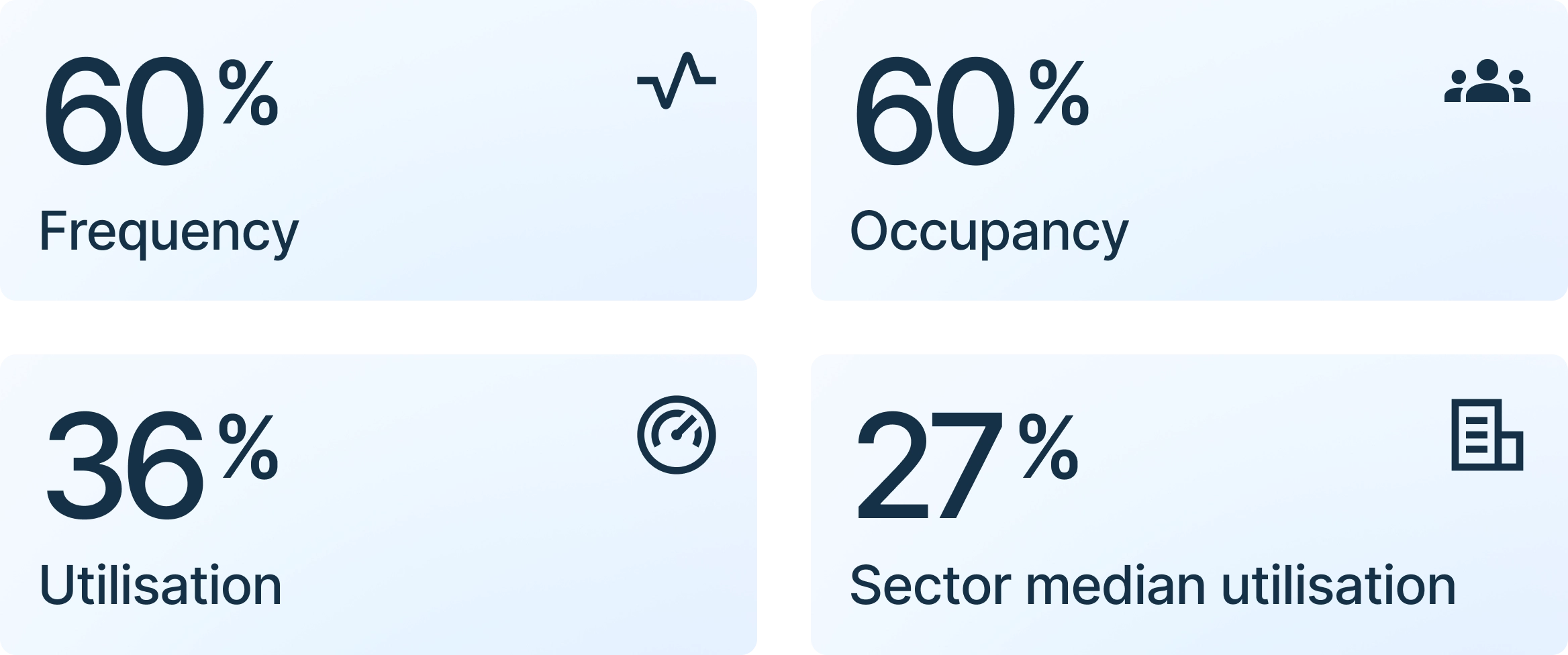
These figures have proved remarkably resilient. Data reported to HESA by the University of Wolverhampton shows the sector median holding at 27% from 2009 to 2015, and the AUDE Estates Management Report (EMR) 2025 confirms that the median remains unchanged nearly two decades later.
This stability tells us something important: the issue isn’t a lack of effort. Universities have transformed how they teach, learn, and work, and it’s a testament to the sector that utilisation rates have remained so consistent despite the upheaval in curriculum delivery and staff working practices particularly since the pandemic. The benchmarks still matter — but we need to use them differently if we are to move the needle on utilisation.
Why Traditional Metrics Need to be Applied Differently
Universities are increasingly less built around fixed timetables and lecture heavy delivery. Today’s estate must support:
- hybrid learning
- active and collaborative pedagogies
- fluctuating attendance patterns
- informal and social learning
- hybrid working for staff
Traditional utilisation metrics capture part of this complexity. They tell us how full a room is, but not whether the space is fit for purpose, supports student belonging, or aligns with academic strategy. Poor utilisation may be a signal of underlying problems — a key line of evidence that something isn’t working as it should.
Informal Learning: The New Heart of the Campus
Informal learning spaces — once treated as “nice to have” — are now central to student experience and retention. While the UK has no mandated benchmark, guidance from the Higher Education Space Management Group (HESMG) and sector practice suggests:
- Design formal rooms for ~70% frequency
- Provide a ratio of 1 informal seat for every 3–4 formal seats with the overflow of students between classes being accommodated by informal seating.
- Plan around 1 m² per person for collaborative areas
These spaces absorb the ebb and flow of student movement, reduce pressure on formal rooms, and support the social dimensions of learning that students increasingly value.
Office Space: The Sector’s Untapped Efficiency Opportunity
Office space is undergoing its own transformation. The British Council for Offices (BCO) suggests a benchmark of:

Meanwhile, the UK flexible workspace sector operates at 80% occupancy (Instant Group, Research Occupancy Analysis Q1 2024). Universities — still largely tied to traditional office models — often fall well below these benchmarks.
In a financially constrained environment, comparisons with the BCO benchmark of 66% workstation utilisation and the 80% occupancy achieved in the flexible workspace sector sharpen the case for change — but they must be applied sensitively. Academics are not desk based full time, and permanently allocating offices for roles that are inherently mobile locks institutions into unnecessary cost. The real opportunity lies in right sizing office accommodation: reducing surplus space and operating expenditure, while ensuring there is still sufficient, high quality quiet space for focused academic work when it is genuinely required.
For Estates Leaders and Policymakers, this represents a major opportunity: rethinking office space can free up resources, reduce energy consumption, and create environments that support collaboration and hybrid working.
The Financial Case: Why Benchmarking Is a Strategic Tool
For senior leaders, the financial implications are impossible to ignore. Analyses from AUDE EMR, Universities UK, and HESA Finance Records show that the built estate typically accounts for:
- 10–12% of a university’s total annual operating expenditure
This makes the estate the second or third largest cost category, after:
- Staff costs (50–55%)
- Teaching and research delivery (30–35%)
- The built estate (10–12%)
Everything else — IT, libraries, student support, marketing — sits far below this.
This means the estate is the largest cost centre that can be strategically reshaped. Staff costs are politically sensitive; academic delivery is mission critical. But space can be redesigned, consolidated, repurposed, and optimised.
Even small improvements matter
For a mid sized university with a £300m annual budget:
- Estate costs = £30–36 million per year (Based on 10-12% of annual operating expenditure)
- A 1% improvement in utilisation can unlock:
- lower energy and maintenance costs
- opportunities to consolidate buildings
- deferral of capital expenditure
- more efficient timetabling
These are not marginal gains - they are strategic levers.
What happens if utilisation improves from 27% to 36%?
Moving from the sector median (27%) to the upper quartile benchmark (36%) represents a 33% improvement in utilisation.
If even a portion of that improvement translates into reduced space demand, the financial impact is significant.
A conservative scenario:
A 10% reduction in required space (well within reach when utilisation improves by a third
- Applied to a £30–36m estate budget
- Delivers £3–3.6 million in annual savings
These savings come from:
- reduced energy consumption
- lower maintenance and cleaning costs
- consolidation of buildings
- deferral of capital expenditure
- more efficient timetabling and room allocation
Over a five year planning cycle, this equates to £15–18 million — enough to fund major capital projects, student experience enhancements, or digital transformation initiatives.
This is why benchmarking matters. It is not about chasing a number; it is about unlocking strategic value.
What This Means for Leaders Across the Institution
For Estates Leaders
Benchmarking provides the evidence to:
- Benchmarking provides the evidence to:
- identify under performing buildings
- prioritise refurbishment
- justify consolidation
- reduce operational overheads
- support sustainability goals
For Academic Leaders
Benchmarking helps academics:
- understand the spatial impact of curriculum design
- align teaching models with available space
- advocate for active learning environments
- engage in evidence based planning
For Policymakers and Governors
Benchmarking offers:
- transparency in estate performance
- evidence for capital allocation
- assurance on efficiency and sustainability
- insight into how space supports student outcomes
Conclusion: Benchmarking as a Strategic Compass
Benchmarking is not about compliance — it is about clarity, academically, financially and strategically. It shapes student and staff experience, and it affects long term financial sustainability.
With median utilisation rates stuck at 27%, and the estate consuming 10–12% of total expenditure, the sector can no longer afford to simply report metrics without acting on them. Modern benchmarking — incorporating real‑time occupancy data, informal learning behaviours, hybrid working patterns, and space quality — offers a practical route to an estate that is more efficient, more adaptable, and better aligned with the future of higher education.
For Estates Leaders, Academics, and Policymakers, benchmarking is a strategic compass. It guides investment, strengthens academic planning, and supports long term institutional resilience.
If you would like to discover how EventMAP is empowering sector partners to transform their estates and achieve their most critical objectives. Take the next step—connect with us through the link below.


